
People experiencing back pain often have many questions regarding the causes of their pain, how to diagnose the problem, and how to treat the condition or injury. Below are several common questions and answers.
What risk factors are associated with back pain?
How is back pain diagnosed?
What is an MRI and what will it diagnose?
If I am claustrophobic, are there any options besides a closed MRI to diagnose my symptoms?
What is a CT scan?
What is a myelogram?
What non-surgical treatments are commonly used to treat mild to moderate back pain?
What types of back injuries or conditions may require surgery?
What non-invasive/non-surgical procedures are available for back pain or injuries?
What can I do to control my back pain?
What causes back pain?
Lower back pain affects as many as 80 percent of adults at some point during their lifetime. Anything from improper lifting to aging may cause back pain. Some of the common causes of back pain include:
- Stretched or strained muscles
- Injuries that damage the muscles, bones or tissue in the back
- Herniated (slipped) discs
- Osteoporosis
- Obesity or excess weight
- Poor posture
- Pregnancy
While back pain is common among adults, if your pain is severe or becomes more frequent, you should talk to your doctor.
[back to top]
Should I see a doctor for my back pain?
Individuals suffering even mild back pain should consult a doctor if they experience[1]:
- Numbness or tingling
- Severe pain that does not improve with rest
- Pain after a fall or an injury
- Pain plus any of these problems:
- Trouble urinating
- Weakness
- Numbness in the legs
- Fever
- Weight loss when not on a diet
[back to top]
What risk factors are associated with back pain?
A number of factors can increase the risk of back pain including[2]:
- Age
- Fitness
- Diet
- Heredity
- Race
- Other diseases
- Occupational risk factors
- Cigarette smoking
[back to top]
How is back pain diagnosed?
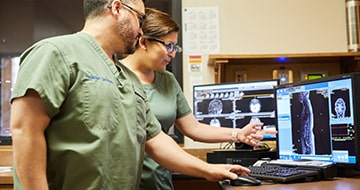
Most back pain can be conclusively diagnosed using one or more of four diagnostic tests. These include:
- X-rays (which show problems like arthritis and bone disease)
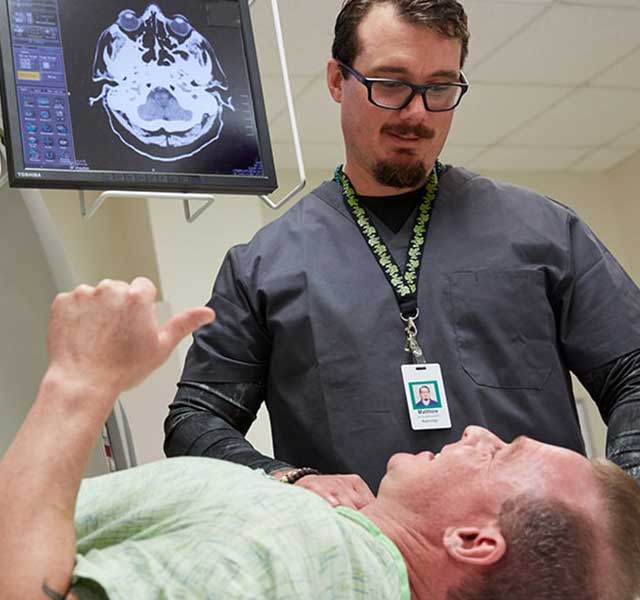
- Computerized tomography (CT) scan
- Magnetic resonance imaging (MRI) test
- Myleogram
[back to top]
What is an MRI and what will it diagnose?
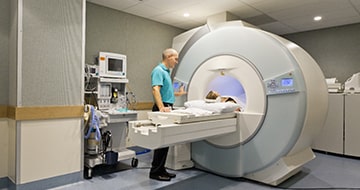
Magnetic resonance imaging, or an MRI, gives clear, detailed pictures of soft tissues near bones, the cardiovascular system and other organs. Specifically for back pain, an MRI allows doctors to look deep inside the body without surgery and can assist in diagnosing herniated discs and nerve damage.
[back to top]
If I am claustrophobic, are there any options besides a closed MRI to diagnose my symptoms?
For those who suffer from claustrophobia (fear of closed spaces) or those who are obese, open MRIs may be an option. This type of MRI allows individuals to feel more comfortable during the procedure.
[back to top]
What is a CT scan?
Computerized tomography, or CT, is an X-ray technique that produces more detailed images of your internal organs than a conventional X-ray can produce. CT scans are used to:
- Diagnose muscle and bone disorders, such as osteoporosis
- Pinpoint the location of a tumor, infection or blood clot
- Guide procedures such as surgery, biopsy and radiation therapy
- Detect and monitor certain diseases such as cancer and heart disease
- Detect internal injuries and internal bleeding
[back to top]
What is a myelogram?
A myelogram is a type of X-ray that uses a dye or contrast material and a special machine called a fluoroscope that takes moving X-rays and displays them on a monitor. Myelograms detect many spinal ailments, including:
- Infection
- Inflammation
- Herniated discs (spinal discs that stick out beyond their normal area) that press on nerves
- Spinal stenosis (a narrowing of the bones of the spine that is often caused by osteoarthritis)
- Spinal tumors and lesions
[back to top]
What non-surgical treatments are commonly used to treat back pain?
Fortunately, most back problems can be treated effectively without surgery. Treatment options include:
- Anti-inflammatory medicine
- Limiting activity
- Physical therapy
- Pain medication as needed
[back to top]
What types of back injuries or conditions may require surgery?
Some conditions or injuries require surgery. These conditions include:
- Compressed spinal cord
- Disk degeneration
- Fractures
- Herniated disc
- Infections or tumors
- Instability in the spine
- Severely pinched nerve
- Spinal stenosis (narrowing of the bones of the spine)
- Spinal deformity
Surgery may also be recommended for those individuals who have symptoms of nerve damage. These symptoms include:
- Pain radiating down the legs or arms
- Acute pain in the affected area
- Numbness
- Weakness or tingling in arms or legs
- Loss of bowel or bladder control
[back to top]
What non-invasive/non-surgical procedures are available for back pain or injuries?
Today, interventional radiologists offer a minimally invasive, non-surgical treatment for spinal fractures. Vertebroplasty (pronounced ver-TEE-bro-plasty) may help reduce or eliminate the pain associated with spinal fractures. This treatment helps stabilize spinal fractures caused by osteoporosis.
[back to top]
What can I do to control my back pain?
Incorporating the following guidelines into your daily routine may help minimize back pain and promote a strong and healthy back and spine:
- Exercise regularly to keep the muscles in your back strong and flexible.
- Stretch before exercising to warm up your muscles.
- Avoid standing or sitting in one position for too long.
- Maintain your proper body weight as excess weight strains your back muscles.
- Use proper lifting and moving techniques.
- Get help if an object is heavy or an awkward size.
- Don’t twist when lifting.
- Avoid smoking.
- Use good posture when sitting or standing.
__________________________________________________________
[1] Handout on Health: Back Pain, National Institute of Arthritis and Musculoskeletal and Skin Diseases, www.niams.hih.gov
[2] Handout on Health: Back Pain, National Institute of Arthritis and Musculoskeletal and Skin Diseases, www.niams.hih.gov
Call our Physician Referral Line at
1-888-284-6641
for more information or to schedule a consultation.